Showing posts with label History. Show all posts

Monday, February 21, 2011

Pérouges (Pay-rouujjj)


Hello! And let me take you on a virtual tour of the Medieval town of Pérouges, France!

This small village is located north-east of Lyon, just 30 minutes by train. The tiny and currently under-construction train station is about a 15-20 minute walk away from the little Medieval village perched on a hill (or 25-45 minute walk- depending on if you take a slight detour like us, and how in-shape you are to make it up the steep gravel mount). There are sheep grazing the hills as you climb up to this blast-from-the-past village (and I do mean... passst). The town was home to farmers, ploughmen, weavers, butchers, and ironworkers.... these craftsmen enjoyed communal freedom as early as 1236 (according to the visitor's website).


The town's name is tied to another city of the same name in Italy (also known as Perogia). A Gallic colony is said to have migrated from Pérouges, Italy to this area of France. The Romans built a look-out tower in this village to defend their prize Lugdunum territory, or Lyon. The first historical date I can find for Pérouges is 1167.... something about some guy taking refuge in the walled-in-city to get away from the troops of the Archbishop of Lyon. So- let's just say- it's purty old:)

You can enter the city through either the Porte d'en Haut or the Porte d'en Bas (high door or low door). We entered through the "low door" arch where you can find an inscription that reads when translated: Perouges of the Perougians, impregnable town, the Dauphiné scoundrels tried to take her but could not do so. However, they took the doors,the hinges and the locks and fell with them. Let the Devil take them! (How dramatic! Perfect for the set of the 3 Musketeer's!) Through this entrance, you continue onto the Rue des Rondes, or what I liked to call it: "the round road"... because it goes around the entire village. Once we had seen all that we could see, we made the loop a second time just for kicks.

When we first arrived, we were pretty hungry from the adventure of getting side-tracked and climbing the baby mountain hill, so we went straight for one of 3 open restaurants in the village- L'Auberge du Coq (or the Rooster's Tavern...?). Their specialties included farm raised roast chicken, the famous Perougian galette au sucre, and grenouilles... Yes- frog legs. And well- when in Pérouges, I say taste the frog legs. For an apéritif, I had a delicious kir... so I was ready for my froggies when they brought them out in the old frying pan and hot plate apparatus. The woman scooped a hearty portion onto my plate... I guess to show me I shouldn't eat them from the pan, and gave me a wet-nap. They are deep-fried in a garlic batter... so as you can imagine, they didn't taste half bad. I had to get used to how many bones were in each little portion... so that got annoying after the first few (I'm not big on having to work too hard for my food lol). Thankfully, they also brought out a huge casserole dish full of the regional favorite gratin dauphinois (or very creamy scalloped potatoes). The bland, but super creamy potatoes balanced out the greasy froggies (with meat that tasted somewhere in between chicken and fish). I can only call them froggies now because it's been a few days since I ate them. I had to try very hard not to think of the frogs-in-wheelchairs scenario when eating them or later that evening. They weren't bad, but I don't think I'll be eating them again...

For dessert, I tried the Pérouges famous galette au sucre. A galette is technically translated as a flat cake made of puff pastry, but the one I had in Pérouges tasted more like a pizza crust covered in sugar. It was nice, but I think I'd rather a nice mousse au chocolat or tarte aux pralines:)

After our lengthy French lunch, we headed back out onto the round street. The streets are very narrow and cobbled. If you ever find yourself in this little town, make sure you have on sneakers. (I can't imagine trying to walk around in high heels!) We were surprised to see cars driving on the narrow streets amongst the modest grey stone houses.... can't imagine that's good for your tires...

Anyway, on our walk, we passed the village's one and only boulangerie, a few gift shops (I bet this place is pretty crowded in the summer), the 15th century fortress church, a 33 meter deep well, la Place du Tilleul (sort of town square), a 13th century Ostellerie, 2 sun dials, and beautiful old houses with wide first-floor windows where merchants displayed goods long ago. The fortress church was built before the siege of 1468, but destroyed by the townspeople themselves to keep it safe. It was rebuilt in the following years, keeping this Medieval church in remarkable condition. It was a cool church (and I do mean cool as in cold too... very drafty!)... with circular windows and wooden statues from the middle ages.

Although the town started to feel a little grey and dim after a while on a chilly February day, it is easy to see why this cité has been voted as one of France's most beautiful villages. I'd like to come back in the spring time when there is a bit more color though! Even still... it's both so rich in history and charm... that the Pérouges visitor's website boasts of a recent visit from former President Bill Clinton and his wife Hil;)

Hope you enjoyed your visit!
Reste cool:)

Wednesday, January 12, 2011

Lyon Resistance Museum

This afternoon I took the tram to 14 avenue Berthelot. This was the site of the Gestapo headquarters from 1942-1944, led by Klaus Barbie. Today, part of the site is dedicated to the French Resistance movement, for which Lyon played a central role, in a museum called the Centre d'histoire de la Résistance et de la Déportation.

This is what I learned today.

Lyon was a part of the "free zone" from 1940-1942. Very near Lyon, to the southeast, Italy occupied an area of France. At this time, about three-fifths of France was occupied, leaving the rest as "libre." Something I didn't realize was that the Vichy government (led by Maréchal Pétain) didn't just rule over the "free zone," or what I thought was the "Vichy zone." The Vichy government ruled over all of occupied France, but in occupied areas, like Paris, German laws trumped the French laws. Pétain's rule was, therefore, most powerful in the southern "free zone."

Pétain collaborated with the Germans, and his French police and milice, or militia, carried out raids on Jews, Resistance fighters, and other "undesirables." From the beginning of this collaboration period, summer of 1940, many French citizens joined the resistance movement. Charles de Gaulle, who fled to Great Britain, gave a radio address calling for the French to resist Nazi Germany. However, as the French were still in shock of the invasion and the changes happening around them, many remained apathetic until 1942, when German forces occupied the remaining part of France, renaming the "free zone," the "south zone."

As you can imagine, France experienced food shortages, fuel shortages, disorganization in transportation, labor shortages (due to high numbers of French prisoners sent to Germany to work as free labor), raids and roundups of Jews, and more while paying host to the German army.... all of which played a part in waking up apathetic French citizens. Although not everyone took part in active resistance, most resisted passively by reading the different publications (newspapers, pamphlets, etc.) or by listening to the radio. I read an interesting "rule book" for the occupied citizens of France. One of the suggested rules was to pretend not to know or to forget any German that you knew when addressed by a German officer. Another rule was to keep only one copy of this document with you (allowing friends to make a copy if need be).

Active resistance members (for which 10-15% were woman, maybe more as many wives helped their husbands or sons) sabotaged transportation and electrical plants, burned bridges, or even participated in guerrilla warfare. There were underground paramilitary groups, called the Maquis, who received weapons, explosives, and ammunition from nighttime parachute landings. They also provided intelligence to Allied forces and carried out rescue missions. The resistance was made up of people from all different social classes, communists, anarchists, Jews, and many foreigners. The Jewish population only accounted for about 1% of the French population as a whole, but in the resistance, they accounted for about 25% of the resistance fighters.... and many Jewish or other persecuted people fleeing from other countries aided in the organized French resistance.

About 76,000 Jews were sent to the concentration camps from France, 13,000 of which were rounded up and arrested in 2 days in Paris (Vel d'Hiv). Of these 76,000, only 2,500 survived. At the time, there was an estimated 350,000 Jews residing in France, many of them were not French, but German refugees. And although France saw a lot of hate, apathy, and collaboration among its clergy, including, for example, a high ranking priest in Lyon, its officials, and its citizens, France is ranked third in the Righteous Among the Nations for the most non-Jews who risked their lives to save Jews during the Holocaust.

The museum had row after row of documents, pictures, and articles written by, for, or about the French resistance and resistance fighters. Countless personal stories were told; a French school teacher hiding Jewish children and teaching them in her house so that they could continue schooling when the war was over, neighbors taking in families or children, resistance leaders imprisoned but rescued by their wives, and on and on. There were also many Lyon related stories... resistance fighters using the famous Traboule passageways in Vieux Lyon to dupe the Gestapo... pictures of floods of people celebrating in Place des Terreaux and Rue de la République after the war was over.... the destruction of the building at 14 avenue Berthelot, after the bombardment of Allied forces in 1944 (targeting train stations and the Gestapo headquarters)... bridges on both sides of Presqu'ile destroyed by bombings or resistance fighters...

The museum is a lot of reading- timelines and quotes every few feet, with the occasional side area to view videos that I couldn't stomach. I left feeling a little sickened, as one usually does after reading or seeing pictures describing genocide. But, one of the last quotes written on the wall went something along the lines of, "What we don't remember about the past, will surely happen again." And so.... I'm very proud that the city of Lyon has this museum to document an important part of its history, in the building that was once the cause of such despicable acts, in hopes that that kind of history will stop repeating itself.

I'm glad that I went. I walk around Lyon and see the Renaissance buildings of old Lyon or the Roman Ruins of Fourvière... but rarely do I picture the Lyon of the 1940's. It's amazing that it all took place here less than 80 years ago...


Sunday, November 14, 2010

A Cours Particulier

Before I explain what my title means, I have something to say: Can someone please turn off the wind? It's a little much. Thanks. (All last night the wind kept me up because it was howling! This morning I decided it probably wouldn't be a good idea to walk to the laundromat with my over-flowing laundry bags because the wind was STILL crazy. And when I went to wait for the bus, I have never felt the wind whip around like it did today! Gah!)

Around 1:30pm, I left for my first meeting with Julien (the son of a teacher I work with at the Simon Signoret school, she's the teacher in the maternelle). Corinne, the teacher, thought it would be a good idea to have desert first to meet and greet before I gave any real English lessons. So... I thought, this won't be too bad, they're giving me desert!

Stupidly, I didn't bring a map or write down any directions from the internet. All I knew was the house address, cross street, and which bus stop to get off at.... thankfully, I got to the bus stop early, and the bus got there early, so I was in the neighborhood of their house with 10 minutes to spare. I walked around aimlessly until I saw the cross street she wrote down and found the grande maison blanche (big white house). I knew I was at the right house because 2 little girls come running out saying in French, "Do you speak English???" And then Corinne came out to unlock the gate (all the houses are gated in this area... more to designate property than security, but I guess it serves a duel purpose).

The whole family came out to greet me, Corinne's husband, her 2 daughters, and her son Julien. They were so funny... it was like they had been waiting for me all day. The little girls were super excited, asking if they were going to get lessons in English too. The dad was falling over himself asking what I'd like to drink and where I'd like to sit. The desert was already all set out... on beautiful china. The desert itself was beautifully prepared... a delicious piece of chocolate cake with what kind of reminded me of caramel rock candy on a stick sticking out of the top and a small bowl of creme anglaise and some sort of poached sugary egg white with caramel drizzled on top (they called the white stuff an island... I still haven't figured out what it really was, but it was GOOD). The kids got to drink sparkling cider and the adults had coffee with sugar out of a cute little china sugar dish. I felt like the queen!

While we ate, they asked me questions about where I lived and how I was finding the job. We talked about tv shows they watched in French, but come from America (Corinne finally gave me an explanation for why so many tv shows in France are actually American... and it's because after WWII, part of the Marshall plan was to import American films and tv series to Europe because the European countries were too poor to produce such luxuries... and ever since then they have continued to have American tv shows, dubbed in French, of course). I felt like the French was sort of a shock to my system because it was spoken so fast, especially with the little girls...and some stuff just got lost in translation... but on the whole... I thought it went pretty well.

Then Corinne asked if Julien would show me the material he's been working on (all the "W" questions and responses)... and then said... would you like to give your first lesson right now? I was like, uh... why not! So they shooed the little girls away, cleaned up the desert, and we got to work. Apparently, Julien is in the advanced language section at school, taking not one, but two foreign languages. His main foreign language is German, his second is English. He showed me his last few English tests and he super failed both. So I guess I understand why his mom was so excited to have me come tutor him. But once we got working, I really didn't think he was that bad. He would take a minute to respond sometimes... or he'd say, "Can you repeat please?" or I'd reform the question with more hand gestures. I think for the most part he just lacks the confidence.... most times he'd say this is going to be wrong, but it was exactly right. When we went over his tests... you could see where he had written something, but second guessed himself and got it wrong. He was very motivated and patient with my French translations... In the end, I'm going to get just as much out of tutoring him because I'm not as afraid to ask how to say something and he enjoys correcting me after I've corrected him haha.

After our lesson, which seemed to fly by, I went upstairs to see the little sisters' rooms (I had to give them some attention too lol). Corinne paid me my 12 euros, we planned for our next lesson (in 2 weeks after Amy leaves), I awkwardly shook Julien's hand (they're not a big hand shaking country, but I didn't know how appropriate the double cheek kiss would be) and I was on my way. I felt bad when I got to my bus because I realized I never said thank you for such a delicious desert... so I emailed Corinne right when I got home.

Now it's time to get ready for my little ones at the Les Marendiers school tomorrow!

Bon dimanche (Have a good Sunday!)

oh and a cours particulier is a private lesson...or like tutoring...


Friday, October 15, 2010

Strike Culture Shock, Quenelles, and some WWII history

The French are known for their cuisine, the arts, their extensive history book, and a fierce pride in their culture. To faire la grève, means to go on strike… which is something else the French know how to do well. I know I’ve already written a little bit about the current strikes and protests (manifestations) going on Nation-wide in France… but, because I was out-and-about today, I saw more of a commotion than I have in the past few weeks.

Today’s plan was to go out to lunch (Lindsey and I are trying out a few new restaurants so that when we have company, we know where to take them!) and to see a movie. I left the apartment a little early, in hopes of getting to the post-office to send a postcard, but alas- my bus was already there, so I ran to catch it. Well- that wasn’t necessary. I sat on this bus for 15 minutes before we started moving. Because of the strike, there were fewer buses in the rotation, and this one sat here gathering people so they didn’t have to wait so long for the next bus to come (I assume). While I was on the bus, I saw the tram take off 3 times… but I figured it would be just my luck if I got off, the bus would leave 30 seconds later.

After the bus ride from hell, (it was SO hot on the bus and the driver kept stopping suddenly, making everyone lurch forward….), I got on the metro towards Vieux Lyon. On the loud-speaker, they told passengers that we would not be stopping at one of the stops (Bellecour- a major metro stop) due to the manifestations. This thankfully didn’t affect me, but when we got to where we should have stopped at Bellecour, we instead slowed down, and sped back up. People who needed to get off were none-too-pleased to have to get off at the next stop and walk. Even with the delays, I got to Vieux Lyon early enough to find myself a post office (Leslie- look for your postcard in the mail!).

After walking through one of the very old covered passageways to cut through to another street (called a traboule) Lindsey and I found ourselves at another bouchon, with a three course menu plan for less than 15 euros. I ordered soupe à l’oignon (or, known to us Americans, French onion soup), some sort of fish in a tomato based sauce, and a tarte au pralines with ice cream for dessert (I know, I’m obsessed with the pralines, but they're just so GOOD!). The soup hit the spot (it was in the low 50’s today), the fish was ok, and the tarte was delectable. Lindsey ordered the Lyon specialty quenelles (which Laurence made me the first day I got here ). She wasn’t too impressed, so I helped her finish itJ I’ve decided that I will stick to ordering quenelles from now on, as well as anything with pralines, when I’m feeling in the mood for a Lyon specialty. (I did a little research because we’re still unsure of what a quenelle is exactly… but Wikipedia says that they are either a mixture of fish, chicken, or meat with breadcrumbs and a light egg binding, or in their most natural form made of semoule (or semolina) which is the coarse, purified wheat middlings of durum wheat used in making pasta. To me, they taste like big fluffy, pieces of pasta. Lindsey said it was a little too mushy for her. They also make a chocolate quenelle… that just looks like the traditional oblong shape… so not to worry, it isn’t made with eggs or wheat middlings! Now the mystery is solved!)

After lunch, which took almost 2 hours (eating takes time, and the French take their time doing so), we speed-walked to catch our movie. On the way there, we passed Bellecour and saw a small demonstration going on. We thought we must have missed the big protest if this was all there was. The movie we went to see was called Elle s’appelait Sarah (which is the translation of the book title Sarah’s Key). I still haven’t read the book, even though it’s on the “to-read” list. The movie theater (not nearly as big as our theaters, but still cool looking) was packed, which surprised us since it was in the middle of the day on a Friday. (I guess all the protestors went to the movies?)

The movie was partly in French, partly in English because it switches back and forth between the WWII era story and the present day story about the American journalist uncovering the other story. The movie was immediately intense, showing Sarah’s family and other French Jews in Paris being taken to Vel d’Hiv (an indoor bicycling racetrack). Then, it switched to the journalistic side of the story, and you learn that the reason this story is so unknown and poorly documented (as the Nazi’s photographically documented everything) is because it was a raid carried out by the French police. It was the largest raid on French Jews in occupied France. These people were taken to Vel d’Hiv as a holding place until they were sent to Auschwitz. I won’t give away the rest of the "Sarah’s Key" story, which is at times very touching, but also truly horrific. After I go to so many Renaissance or Medieval era monuments, I forget how much history there is around here from not very long ago… and I think about how much this still must be a part of their European identity. There is supposed to be a great museum in Lyon on the French Resistance movement during WWII… it’s on my list.

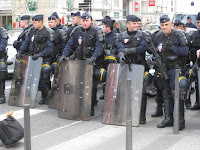
It was a weird transition coming out of the dark theater and into the sunlight with protests going on in Bellecour. There were police with riot gear on and more crowds of people. I noticed for the most part, the crowds were of young people. When you hear about these retirement reforms, you mostly think it’s the aging population who are being affected and who are the most likely to strike. But, if these people have to work 2 years longer, that’s 2 more years that the younger population will be without jobs… so I guess they have just as much to strike about.

Lindsey and I have a big day planned for tomorrow (going to Chambery) so after a few pictures, we went our separate ways to head home. I took the metro from Bellecour that was working again, and got off to take the tram home (assuming that the bus would be a nightmare again). I got off the metro, and ran to catch a tram about to leave. Unfortunately, I just missed the tram by 5 seconds, the doors closing in my face. The tram notifier said the next one wouldn’t be arriving for another 21 minutes, so I dashed across the street to see if there was a bus I could catch. While I was across the street, another tram came through! I was so frustrated. So I went and sat my butt down to wait it out for another tram… which didn’t come for 20 minutes. Needless to say, I was feeling the strike culture shock at this point. The other people waiting were annoyed, but when you heard them talking about it, they just said, “ah, yes, this is because of the strikes…” like it’s just a normal part of life (which for them it is).

I finally got on a tram and got home! Now it’s time to relax, plan how I’m getting to the train station tomorrow if the buses are all messed up again, and praying that the strikes and weather don’t rain on my parade! (My train's already been canceled, so we're hoping to get a later trip in...)

Reste cool!

p.s. Thank you to all of my readers... for reading!

I had a request to comment on whether college is free for students in France…. And the answer is, yes! Sort of! The French pay a lot of taxes, but in the end are rewarded with universal health care, pension plans, and very low cost college tuition, among other benefits. University is done quite differently in France… students must take an exam at the end of highschool (the Bac), giving them access to university (for free). Many students go into preparatory classes first, especially for engineering or medical tracks. Only some schools, like the Sorbonne, and private or specialized business schools require a tuition, and they are nothing compared to the cost of American tuitions. On the other hand, going to college in France rarely means going off to a school to live in a dorm and having state-of-the-art facilities included in tuition (like gyms or student commons like in the US). There you have it in a nutshell!